Listen to this article 10:59
Jump to a section
Read aloud by an AI voice (ElevenLabs) from the text on this page, which is the full transcript. Tables are summarized in the audio; see them below.
Of the 15,418 houses inside Austin city limits that the appraisal district lists as built in the 1960s, 1,798 have had at least one City plumbing permit to repair, replace or reroute the sewer line since 2015. That is 11.7 percent, a little more than one in nine. For houses built since 2000, the share is about one in a hundred.
The pace is picking up, too. Between January 1 and November 24 of this year, plumbers applied for 695 residential sewer line repair permits in Austin. That is 17 percent more than in the same stretch of 2025, and the most for that period in any year since 2015, the first year in our copy of the records.
If you are buying an older Austin house, the sewer line is one of the few big-ticket systems a standard home inspection is not required to look at. Here is what the permit record shows, what the rules say, and what to check while you still have your option period.
The 1950s and 1960s stand out
We matched every residential sewer line permit since 2015 to the appraisal district's record for the house, then counted houses, not permits, so a house with two permits counts once.
| Decade built | Houses | With a sewer line permit | Share |
|---|---|---|---|
| Before 1950 | 12,540 | 802 | 6.4% |
| 1950s | 12,850 | 1,180 | 9.2% |
| 1960s | 15,418 | 1,798 | 11.7% |
| 1970s | 25,192 | 914 | 3.6% |
| 1980s | 24,472 | 428 | 1.7% |
| 1990s | 20,846 | 288 | 1.4% |
| 2000s | 24,812 | 304 | 1.2% |
| 2010 and later | 23,289 | 230 | 1.0% |
| All houses | 159,419 | 5,944 | 3.7% |
Houses built before 1970 are about a quarter of the houses in the city, 25.6 percent. They account for 63.6 percent of the houses with a sewer line permit.
The drop after the 1960s is steep. A 1970s house is about a third as likely as a 1960s house to show up in this record, and a house from the 1990s about an eighth as likely. The permit descriptions give a hint why: plumbers working on older houses write "cast iron" far more often. Of the 420 permits on these houses since 2015 whose description names cast iron, 366 are on houses built before 1970.
Slab or pier and beam decides how the work gets done
The appraisal roll also records each house's foundation, and it lines up with the era. Of houses built before 1950, 87.9 percent are listed as pier and beam. Of houses from the 1960s, 91.2 percent are on a slab. The 1950s are the crossover decade, split about evenly.
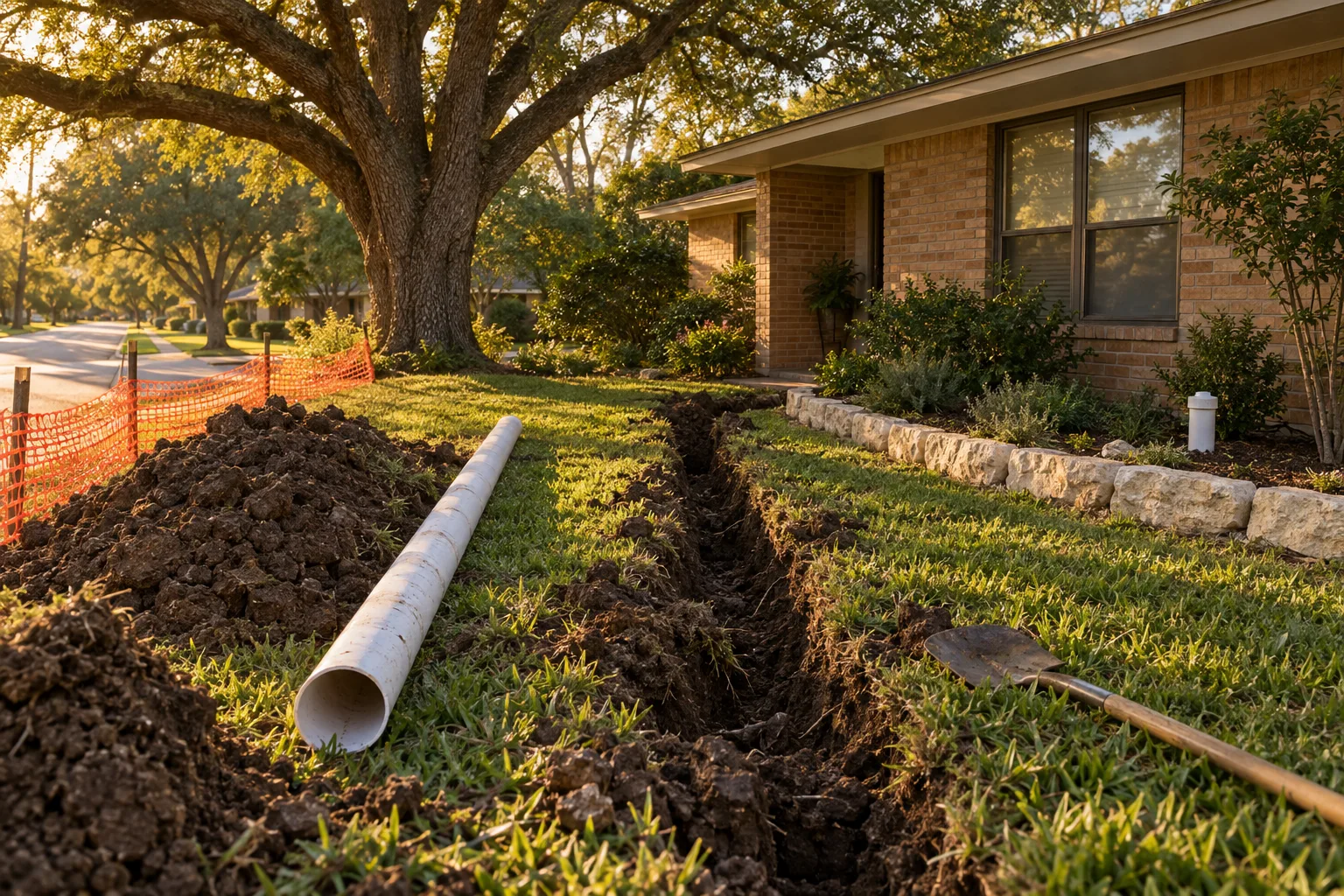
That matters because a drain line under a slab can only be reached by breaking the floor or by digging a tunnel under it from outside. Of the 1,872 sewer permits filed on 1960s houses since 2015, 834 describe a tunnel, 44.6 percent. On houses built before 1950, where a plumber can usually crawl under the floor, only 46 of 817 permits mention one, 5.6 percent.
The descriptions read like a field notebook: "Tunnel up to 10 ft to expose and replace cast iron sewer line under home," "Replace sewer yard line from house connection to City tap," "spot repair to the sewer line in the yard next to a tree." Some come bundled with foundation work, because a broken drain under a slab and a settling foundation are often the same story.
| Year | Permits, Jan. 1 to Nov. 24 | Permits, full year | Share describing a tunnel |
|---|---|---|---|
| 2015 | 493 | 546 | 15.9% |
| 2018 | 486 | 532 | 25.9% |
| 2021 | 600 | 644 | 34.0% |
| 2024 | 588 | 634 | 32.5% |
| 2025 | 593 | 636 | 39.6% |
| 2026 | 695 | not yet | 37.6% |
Tunnel jobs went from about one in six sewer permits in 2015 to well over a third in 2025 and 2026. We can't tell from the record whether that reflects older slab lines giving out, more owners choosing to replace the whole run under the house, or plumbers simply describing the work in more detail.
Whose pipe it is, and what the inspection covers
Austin Water calls the pipe from your house to its system the private lateral and describes it as "customer-owned wastewater piping." When the utility finds a defect, it says, "property owners may be required to repair the lateral." The rules sit in Austin City Code Chapter 15-11, and the repair needs a City plumbing permit through Development Services, which is the record we counted.
The utility also points to a Private Lateral Grant Program run by the Austin Housing Department. It repairs or replaces a defective lateral at no cost for qualifying single-family homeowners with household incomes at or below 100 percent of the area median family income. The number listed is 512-974-3100.
On the inspection side, a Texas home inspector working under the Texas Real Estate Commission's plumbing standards has to report deficient waste pipes and poor fixture drain performance. But TREC's general standards say the inspector is not required to inspect "anything buried, hidden, latent, or concealed," and the plumbing rule says the inspector need not look for sewer cleanouts. A line under a slab or a lawn is, by definition, buried.
So a camera inspection of the sewer line, often called a sewer scope, is something you order on top of the standard inspection. The current TREC One to Four Family Residential Contract (form 20-19, dated May 4, 2026) lets the buyer have the property inspected by inspectors the buyer selects, and says any hydrostatic testing, a pressure test of the drain system, "must be separately authorized by Seller in writing." TREC publishes an addendum for that.
The seller's side has a matching question. The Seller's Disclosure Notice required by Texas Property Code §5.008 asks whether the seller is "aware of any item, equipment, or system in or on the property that is in need of repair."
Four checks before your option period ends
- Read the permit history for the address. In the City's Issued Construction Permits data, look for a plumbing permit with "sewer" in the description. A Final permit for a full replacement is useful news. An Expired one means the work was never signed off; 16 percent of the sewer permits filed from 2015 to 2025 ended that way.
- Check the year built and the foundation. Both are on the appraisal district's record for the house. A 1950s or 1960s slab house with no sewer permit on file is the combination worth a camera.
- Order the scope early. The option period is however many days your contract says, and a scope needs an accessible cleanout. If the camera finds a belly, a break or root intrusion, you want time for a plumber's written estimate before the option deadline, which the contract sets at 5:00 p.m. local time.
- Ask for the paperwork. If the seller had the line replaced, the permit number, the plumber's invoice and any video are worth more than a verbal "we redid the plumbing."
What this means if you're buying or selling here
Buying. The houses most likely to have needed sewer work are the mid-century ranches on slabs, built in the 1950s and 1960s. A permit on file is not a red flag. It can mean the expensive part is already done. No permit on a 60-year-old house is not a verdict either; it just means nobody has a public record of the line. The scope is how you find out.
Selling. If your house is from the 1950s or 1960s and you have replaced the line, put the permit and the invoice in the disclosure packet. If you have not, a pre-listing scope lets you decide on your own schedule whether to repair, disclose or price it in, instead of finding out from the buyer's inspector during the option period.
None of this is advice about a particular house. A licensed plumber, a TREC-licensed inspector or your agent is the right person for that.
Where to look next
- The other big system under a slab: foundation repair permits in Austin.
- Last week's permit check: AC change-outs, and why most 2000s houses show none.
- Why an open or expired permit matters at closing: expired home permits before you buy.
- Flood, tax and parcel context for a specific address: our address research tool.
How we pulled this
We counted City of Austin residential plumbing permits (type PP, permit class Residential) whose description mentions a sewer line together with repair, replacement, rerouting, tunneling, pipe bursting, a broken line or cast iron, in the Zabalist research database, which mirrors the City's Issued Construction Permits dataset. Each permit number is counted once, by application date, and void, withdrawn and cancelled permits are left out. As a check, we counted every 2025 and 2026 residential plumbing permit mentioning "sewer" both in our copy and in the City's live open-data feed (last updated November 25, 2026): 686 against 691 for 2025 and 744 against 751 for 2026 through November 24, so our counts may run about 1 percent low. Houses are Travis Central Appraisal District state code A1 records with a main improvement of "1 FAM DWELLING" on the 2026 roll, placed inside Austin city limits by parcel centroid using the CAPCOG regional city-limits layer (Austin boundary updated August 19, 2026). Permits match houses on the appraisal parcel number. Sewer work filed under a remodel or addition permit, work done before 2015 and work done without a permit are not counted, so the shares are a floor, not a full history. A permit is an authorization to do work; it does not describe the condition of any particular line. Percentages are our arithmetic. This is a count of public records, not a market statistic.
One next step
If you are weighing an older Austin house, talk to a local Austin Local Team agent about the address's permit history before your option period starts.