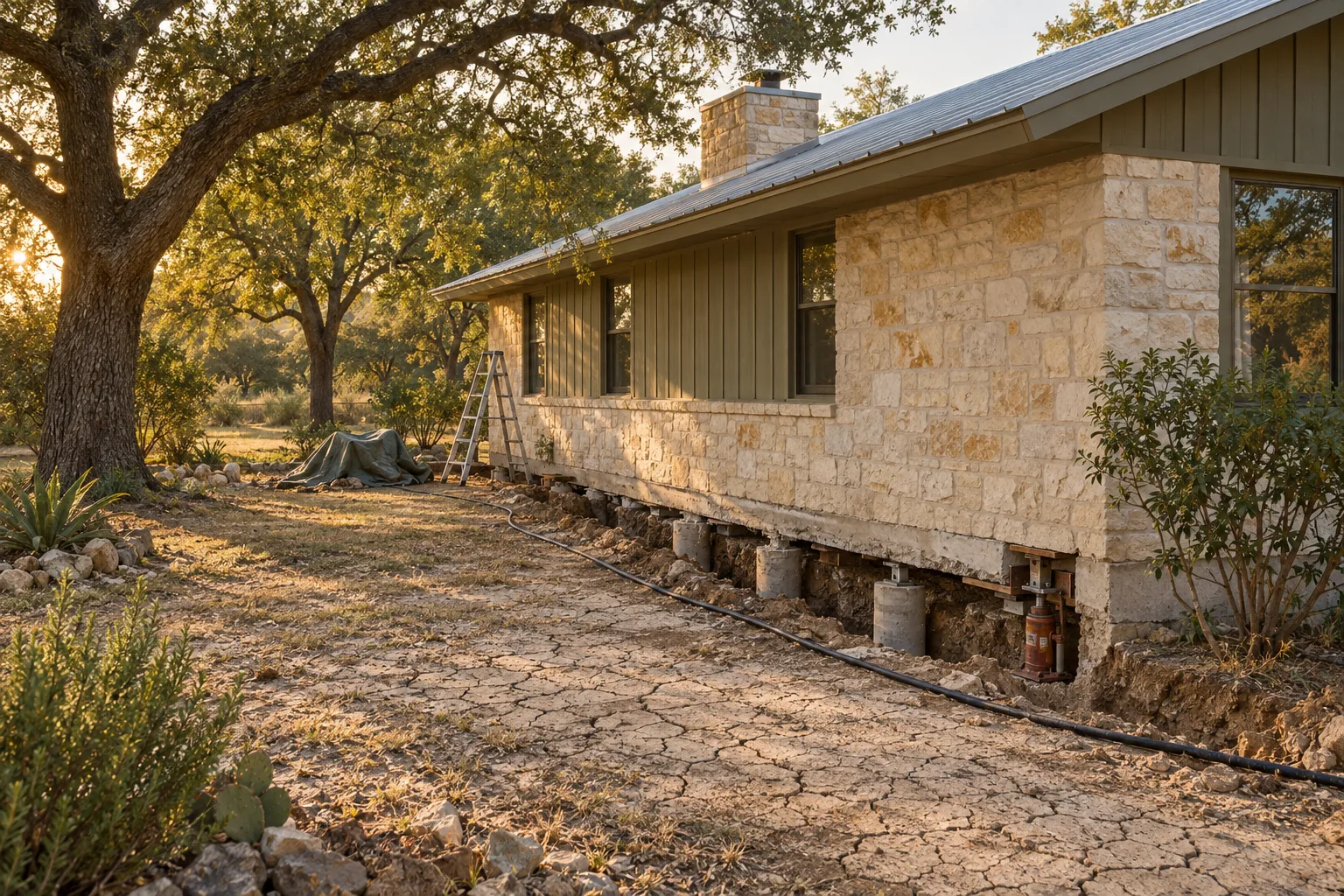
From January 1 through October 9, the City of Austin issued 825 residential permits whose description says foundation repair. In the same stretch of 2025 it issued 557. That is 268 more, a rise of 48 percent, and the 2026 count is already above the full-year 2025 total of 761.
These are permit records, not a count of damaged houses. A permit says someone applied to repair a slab or pier-and-beam foundation and the City cleared it. Still, a jump this size after four flat years is worth reading carefully if you own a house in Austin or are about to buy one.
The count, year by year
We counted every issued permit in the City's residential class whose description contains "foundation repair," for January 1 through October 9 of each year, so the windows match.
| Year | Permits |
|---|---|
| 2019 | 385 |
| 2020 | 345 |
| 2021 | 389 |
| 2022 | 383 |
| 2023 | 482 |
| 2024 | 465 |
| 2025 | 557 |
| 2026 | 825 |
Source: Austin Local Team analysis of the City of Austin Issued Construction Permits file (dataset 3syk-w9eu, last updated by the City Oct. 12, 2026 at 12:17 UTC; pulled Oct. 13, 2026). Our own copy of the City's permits in the Zabalist research database, last synced Oct. 12, 2026, gives 794 for 2026 and 529 for 2025 under a slightly different matching rule; the direction and size agree. The City's file is the one we cite.
Between 2019 and 2022 the number sat in a narrow band, 345 to 389. It moved to 482 in 2023, dipped to 465 in 2024, and then climbed in two steps.
One thing did not change. In every year since 2023, 95 to 98 percent of these permits carry "Express" at the start of the description, which is the City's one-day track for small jobs. In 2026 it is 788 of 825; in 2025 it was 533 of 557. So the jump is not the result of the City relabeling these permits or opening a new route for them.
Where the permits are
The permits came from 37 different ZIP codes this year, but a handful carry a lot of them. ZIP codes are mailing areas, not neighborhoods, and the permit file records the ZIP of the job address.
| ZIP | 2025 | 2026 |
|---|---|---|
| 78745 | 49 | 85 |
| 78754 | 48 | 84 |
| 78748 | 39 | 83 |
| 78747 | 40 | 65 |
| 78723 | 45 | 52 |
| 78741 | 31 | 44 |
| 78744 | 44 | 42 |
| 78724 | 20 | 36 |
| 78704 | 32 | 32 |
Source: same City file and pull date as above. The top four ZIP codes, 78745, 78754, 78748 and 78747, account for 317 of the 825 permits, or 38 percent. A permit count says nothing about how many homes are in a ZIP, so a bigger number is not a worse area.
Three ZIP codes rose by 73 to 113 percent (78745, 78754 and 78748). Two did not move: 78704 held at 32 and 78744 dipped from 44 to 42. If the cause were one citywide change in permitting, you would expect the increase to be more even. It isn't.
What soil and weather have to do with it
Much of Austin's housing sits on clay that swells when wet and shrinks when dry. The Texas Department of Licensing and Regulation says so in plain terms in a technical bulletin on foundations on expansive soils: soils "that shrink and swell due to changes in moisture content, are a very common cause of foundation problems." High moisture heaves a building up; low moisture lets it settle. The bulletin also lists proper surface drainage, plant choices and sprinkling practices among the things that limit swings in soil moisture.
2026 was a dry year here. The U.S. Drought Monitor publishes weekly county maps, and we pulled the series for Travis County. The share of the county in the "extreme drought" category (D3) was 96.7 percent on the week of January 13 and 99.96 percent the week of January 20. It stayed between 71 and 77 percent from late January through the week of May 5, was 48.98 percent from mid-May through the week of June 2, and then dropped to zero for the maps from June 9 through September 15. It came back in the last two weeks of September, at 22.0 and 37.5 percent, and was zero again on the map for the week of October 6, when severe drought (D2) covered 78.9 percent of the county. In all, 23 of the 40 weekly maps this year showed some extreme drought in Travis County.
| Month | 2025 | 2026 |
|---|---|---|
| January | 55 | 87 |
| February | 53 | 81 |
| March | 66 | 111 |
| April | 70 | 105 |
| May | 56 | 99 |
| June | 40 | 87 |
| July | 68 | 66 |
| August | 47 | 65 |
| September | 83 | 85 |
Source: City of Austin Issued Construction Permits file, pulled Oct. 13, 2026, by issue date. Drought figures: U.S. Drought Monitor county statistics for Travis County (FIPS 48453), weekly maps through the week of Oct. 6, 2026, pulled Oct. 13. Drought Monitor classes are defined on its classification page.
The two lines move together in 2026: the most permits, 111, 105 and 99, came in March, April and May, when extreme drought covered most of the county, and the count fell to 65 and 66 in August and July. We are not claiming the weather caused a given repair, and permit records do not tell us why an owner did the work. What the records do show is that the jump has a season to it.
Of the 825 permits, 189 mention piers in the description, for example a job that installs a set number of piers under an exterior wall. We have not seen the engineering behind any of them.
How a repair gets permitted
The City lists foundation work on its Express Permits page: "repairing without increasing impervious cover in excess of 128 sq. ft." It says "the turnaround time to issue most Express Permits is one business day," and adds that the timeframe may differ if the property is within a floodplain or historic district. A plumbing permit may also be required depending on the work. If the job grows past what Express covers, the page says a regular residential building permit and fees are needed.
That is why so many of these are Express permits. The City's open permit file lists the address, the issue date and a description for each one, so a past repair at a specific house can be found there.
What this means if you're buying or selling here
Buying. The Texas Real Estate Commission's Seller's Disclosure Notice (the form version dated 09-01-2019, as posted by TREC) lists "Foundation/Slab(s)" among the items a seller says whether they know of defects in. Item 4 asks about "Previous Structural or Roof Repair," and item 9 asks about "Room additions, structural modifications, or other alterations or repairs made without necessary permits." A permit number for a past repair gives you something concrete to ask for. Ask for the repair paperwork, who did the work, and any warranty terms, and read what a warranty covers before counting on it, since it is a contract between the owner and the repair company.
Selling. If you did foundation work, the permit and the paperwork are the first things a buyer's agent will ask about, and the disclosure form asks you to answer for what you know. Keep the permit number and the repair documents in one folder.
Owning. The state's bulletin points to drainage and consistent soil moisture as the controllable pieces. How much watering, if any, suits your lot depends on your soil and your foundation, so ask a licensed structural engineer rather than copying a schedule from a neighbor.
For tax, lending or legal questions about a specific repair, talk to the appraisal district, a lender or an attorney. This article is general education, not advice about any house.
How we counted
We used the City's Issued Construction Permits file and kept permits in its residential class whose description contains the phrase "foundation repair," counted by issue date. That picks up permits whose description uses those words. It will miss repairs described differently, such as "pier installation" with no mention of repair, and will include a few that mention foundation repair as part of a larger remodel. The same rule is applied to every year, so the comparison holds even if the absolute count is not complete. The City file's newest issue date was Oct. 12, 2026; we cut the windows at Oct. 9 so each year covers the same days. We checked our result against our own synced copy of the City's permits in the Zabalist research database; the data-source page there flagged a sync error on Oct. 12, so we did not use it for the published figures.
To start research on an address, the Austin home research tool returns the mapped flood zone and geologic unit with their sources; neither says anything about the condition of a particular foundation, so an engineer's report is still the answer to that. Our ZIP code pages carry area-level records. Last week's piece on remodel and addition permits uses the same file for a different kind of work, and the property tax bill piece covers what a closing looks like in November.
If you are looking at an Austin house and want a second set of eyes on its permit history before you write an offer, talk to a local agent on our team.