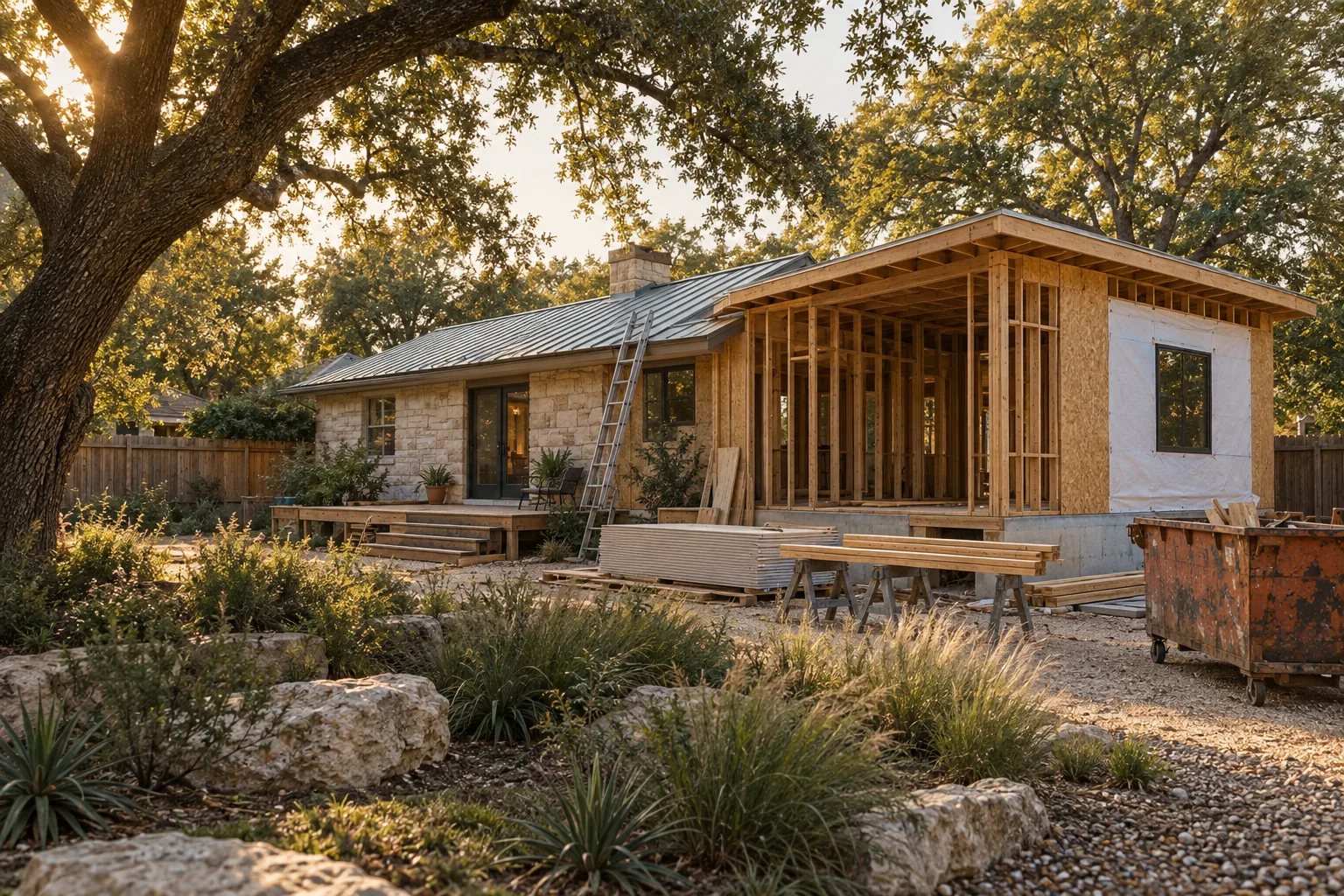
From January 1 through September 27, the City of Austin issued 909 building permits in its class for additions and alterations to houses. That is 63 fewer than the same stretch of 2023, a drop of 6.5 percent, and 11 fewer than 2025. The weekly count has hovered between 19 and 30 for the last nine weeks.
Last Sunday we counted the permits for brand-new houses. This week is the other half of the housing record: the permits people pull to change a house they already own. If you are buying a home that someone has worked on, or about to start work on your own, this counter is the one that touches you.
The count, year by year
We counted City of Austin building permits (permit type BP) in the class "R- 434 Addition & Alterations," grouped by issue date. It does not include new houses or the separate class the city uses for mobile-home additions.
| Year | Jan. 1 to Sept. 27 | Full year |
|---|---|---|
| 2022 | 1,063 | 1,394 |
| 2023 | 972 | 1,274 |
| 2024 | 968 | 1,242 |
| 2025 | 920 | 1,172 |
| 2026 | 909 | in progress |
Read left to right, it is a slow slide rather than a cliff. The full-year total fell from 1,394 in 2022 to 1,172 in 2025, about 16 percent. This year is running 1.2 percent behind 2025 at the same date. Our own copy of the records, in the Zabalist research database, shows 908 for 2026 through September 27 (last synced October 10, 2026), one fewer than the city's feed. Its history before 2026 is only partly loaded, so every year above comes from the city's feed.
The last nine weeks
| Week beginning | Permits issued |
|---|---|
| Aug. 3 | 19 |
| Aug. 10 | 29 |
| Aug. 17 | 24 |
| Aug. 24 | 27 |
| Aug. 31 | 19 |
| Sept. 7 | 30 |
| Sept. 14 | 26 |
| Sept. 21 | 28 |
| Sept. 28 | 23 |
| Oct. 5 (Mon.-Fri., 21 so far) | not final |
Those nine full weeks add up to 225, an average of 25 a week. The week of Labor Day, September 7, was the busiest of the nine, so there is no holiday dip to explain. The current week is incomplete: the city's feed runs through Friday, October 9, and recent permits can keep arriving for days after they are issued.
What the permits say they are for
Each permit carries a short description written at filing. We searched those descriptions for common words. A permit can mention several things, so the rows overlap and do not add up to 909.
| Description mentions | 2025 | 2026 |
|---|---|---|
| Bath | 351 | 385 |
| Porch, deck, patio or pergola | 320 | 348 |
| Kitchen | 200 | 209 |
| Garage | 171 | 191 |
| Second story or second floor | 102 | 86 |
| Accessory unit, guest house or garage apartment | 32 | 33 |
Bathrooms show up in about 42 percent of this year's permits (385 of 909), porches and decks in 38 percent, kitchens in 23 percent. Mentions of a second story fell from 102 to 86. The reading we can stand behind is modest: more of the work being permitted this year is about rooms and outdoor living space than about adding height.
The permits also record added or altered floor area. About two in three of this year's permits (589 of 909) list a square-footage figure. Among those, the median is 457 square feet, against about 445 last year. By size:
- 172 permits list 250 square feet or less
- 144 list 251 to 500
- 146 list 501 to 1,000
- 127 list more than 1,000
The rest list no figure, so treat these as a sample of the records, not the whole pool. The permit valuations in the city's feed are not usable: on this class the valuation field reads $1 on the typical permit, so we did not rank projects by cost.
Where the permits were issued
| ZIP | 2025 | 2026 |
|---|---|---|
| 78731 | 82 | 106 |
| 78757 | 67 | 69 |
| 78704 | 81 | 68 |
| 78703 | 80 | 65 |
| 78759 | 51 | 62 |
| 78745 | 47 | 55 |
78731 went from 82 to 106, the largest jump of the six. ZIP codes are a mailing convention, not a neighborhood, and these counts say nothing about the people who live in them. They record where the city issued permits. Of this year's 909, 887 are in the city's "Austin Full Purpose" jurisdiction.
How the city sorts this work
The City of Austin Development Services Department splits house work into lanes, and the lane decides how long you wait. On its residential plan review page, with timelines effective July 1, 2026, the city lists 5 business days for an interior remodel and 10 business days for new construction and additions. It also says that "Raising a house roof is considered an addition."
The city's express permit page covers smaller jobs: kitchen and bathroom remodels with restrictions, roofing, siding over 128 square feet, same-size window replacement and similar work. It says most express permits are issued in one business day, but the walls cannot be moved or removed and plumbing fixtures cannot be added or relocated. Go past that and "you'll need a new residential building permit application," which the city says may delay the project. Our count tracks the building-permit class for additions and alterations, so it is not a count of every small job in town.
If you are the homeowner, the city's homeowner permitting page says you can register to act as your own contractor, and points to a "Do I Need a Permit?" guide or the city's number, 512-978-4000, for a definitive answer on your project.
What this means if you're buying, selling or renovating here
If you are buying a house that has been worked on. Texas's standard Seller's Disclosure Notice (TREC form OP-H) asks the seller whether they are aware of "Room additions, structural modifications, or other alterations or repairs made without necessary permits or not in compliance with building codes in effect at that time." A bath or a room that looks new is a reason to ask which permit covers it. The city lists issued permits by address on its open data portal, and each record carries an issue date and a status. A missing permit is a question for your agent and your inspector. It is not a verdict.
If you are selling. The same form line applies to you. Gather the permit numbers for work you have done before you list, so the answer to that question is a document, not a memory.
If you are planning to renovate. Decide early which lane your project sits in. A kitchen or bath refresh with the walls where they are can go through the express lane. Moving a wall, adding a room, converting a garage or raising the roof puts you in the longer review. The city's own current timelines are above; they are not a promise for your lot, especially in a floodplain or a historic district, where the city says express permits can take longer.
Our partner research site Zabalist keeps the permit history by address and by contractor: see the permit records there. For last week's other half of the permit story, see Austin permitted 1,205 new houses in eight weeks, and for what a closing does with the tax bill, Austin's 2026 tax bill and what it does at closing.
This piece is general information, not advice about a specific property, permit or contract. For a particular house, ask a licensed inspector, the city, and your agent.
How we counted
The source is the City of Austin's Issued Construction Permits dataset, which the city updated on October 10, 2026, with the latest issue date October 9. We selected permit type BP and permit class beginning "R- 434," grouped by issue date, ZIP on the permit address and the permit description. Year-to-date figures cover January 1 through September 27 of each year, so every year is cut at the same date. Percent changes, weekly averages and the description search are our arithmetic and text matching. No owner names, house numbers or MLS data were used, and this piece makes no statement about home prices or sales.
One next step
If you are looking at a house that has clearly been remodeled, a local agent can pull the permit record for that address with you before you make an offer. Start at our get started page.