Listen to this article 7:31
Jump to a section
Read aloud by an AI voice (ElevenLabs) from the text on this page, which is the full transcript. Tables are summarized in the audio; see them below.
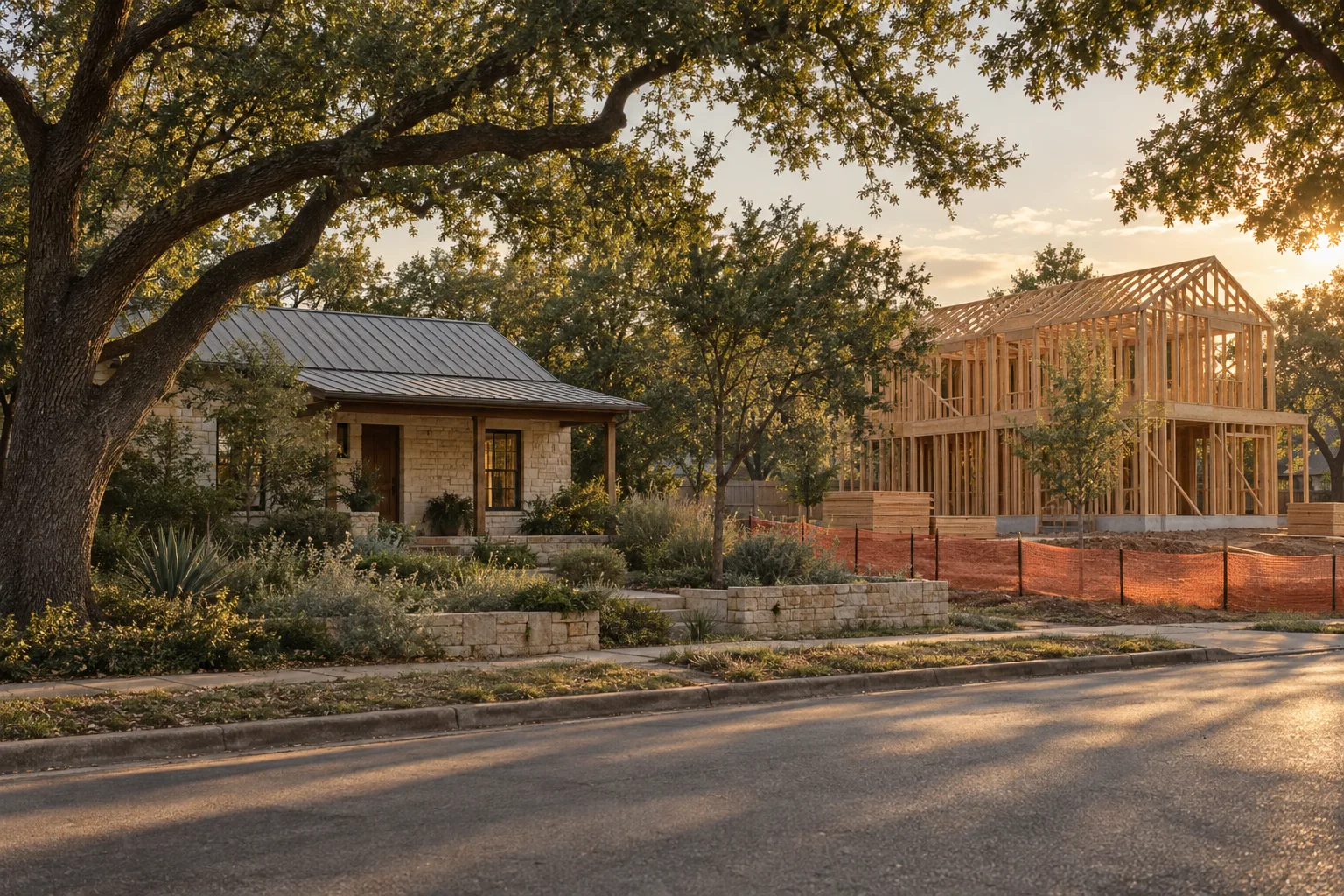
From January 1 through November 8, 2026, the City of Austin issued 394 demolition permits for one-family houses. Sixty-six percent of them, 260, sit in five ZIP codes: 78704, 78702, 78757, 78703 and 78745. October was the busiest month of the year, with 46.
That is a count of paperwork, not a count of teardowns that were rebuilt. But it tells you where, on the permit desk's own books, existing houses are coming off the ground, and it points to a handful of questions worth asking if you are buying next to one of those lots, or buying a house old enough that someone might want to replace it.
394 so far, down 8% from 2025
| Year (Jan. 1 to Nov. 8) | One-family demolition permits |
|---|---|
| 2019 | 541 |
| 2020 | 435 |
| 2021 | 664 |
| 2022 | 657 |
| 2023 | 366 |
| 2024 | 349 |
| 2025 | 429 |
| 2026 | 394 |
The 2026 figure is 8% below the same stretch of 2025 and 40% below 2022, when the same window shows 657. The monthly pace has been steady: 40 in January, 37 in February, 41 in March, 33 in April, 34 in May, 41 in June, 32 in July, 43 in August, 40 in September and 46 in October. Seven more were issued in the first week of November. The 394 permits cover 374 distinct street addresses, so a few addresses carry more than one permit.
Where the permits are
| ZIP | Demolition permits 2026 | Same dates 2025 | New house permits 2026 |
|---|---|---|---|
| 78704 | 61 | 70 | 115 |
| 78702 | 55 | 45 | 90 |
| 78757 | 52 | 64 | 81 |
| 78703 | 47 | 38 | 63 |
| 78745 | 45 | 51 | 158 |
| All five | 260 | 268 | 507 |
Together the five ZIPs hold 66% of this year's permits and held 63% of last year's (268 of 429). Below them the list drops quickly: 78731 has 27, 78746 has 19, 78751 has 14, 78722 and 78756 have 12 each. Among the five, 78702 (up 10) and 78703 (up 9) issued more than in the same dates of 2025, while 78757 (down 12), 78704 (down 9) and 78745 (down 6) issued fewer. 78746 went from 10 to 19.
The right-hand column shows why a demolition count alone misleads. In 78745 the City issued 158 new-house permits against 45 demolitions, which fits an area where much of the building is on lots that did not hold a house before. In 78704 the ratio is closer, 115 to 61. We did not try to pair each demolition with a later house on the same lot: addresses in the permit feed do not always match from one permit to the next, and a match we could not defend would be worse than none.
What the City says happens before a house comes down
The City of Austin's demolition permit page says residential structures 45 years or older require review by the Historic Preservation Office in Austin Planning, and possibly the Historic Landmark Commission. For a house built before 1981, in other words, a demolition is not just a contractor's form. The page does not state how long that review takes.
The same page says total demolitions require a pre-demolition inspection and notification to adjacent residential structures. The contractor's notice window is five to 10 business days before demolition activity, and the five-day minimum starts the day the acknowledgment is uploaded. Some homes can be relocated instead, and work that affects a protected-size tree (19 inches or more in diameter) may need a tree permit review.
What this means if you're buying or selling here
- Buying a house next to a vacant or fenced lot. Look the address up on the City's demolition process and Development Tracker pages. A demolition permit tells you work was authorized; a new-house permit at the same address, if one exists, tells you what is planned. Construction can run for many months, and the permit records show the dates.
- Buying a house built before 1981. Ask what review any future demolition or major change would face. The City's 45-year rule applies to the structure, not to the lot's price or the neighborhood around it.
- Selling a house on a lot others might redevelop. The permit count says nothing about your home's value. Nobody can promise what a lot will sell for, and this article makes no such claim. What you can do is have your own permit history, including any expired permits, in hand before a buyer asks. Our piece on expired home permits explains why that matters.
- Renting near a site. A demolition notice goes to adjacent residential structures. Ask your landlord whether one has been received for the neighboring lot.
Where to look next
- The City's demolition permit page for the review, notice and tree rules above.
- Our guide to finding what is being built near an address.
- Permits on a single house, by ZIP, in our ZIP house-size piece and our Mueller permit record, for what a finished neighborhood looks like in the same data.
- Site-plan and subdivision filings, which are a separate record from house permits, are searchable on Zabalist.
How we pulled this
We counted City of Austin building permits (type BP) with work class Demolition and permit class "R- 645 Demolition One Family Homes," by issue date, in the Zabalist research database, which mirrors the City's Issued Construction Permits dataset. The sync timestamp and latest source date are in the table captions. ZIP is the ZIP code on the permit record. "New house permits" are type BP, work class New, classes R-101 (single-family houses, 1,881 so far this year), R-102 (2) and R-103 (two-family buildings, 127). Percentages and the year-over-year changes are our arithmetic. Two-family demolitions (class R-646) and other residential demolitions (R-649, which includes garages and accessory buildings) are not counted here. A permit is an authorization; this data does not show whether, or when, a house was actually demolished or what replaced it. This is a record count, not a market statistic, and it contains no MLS data.
One next step
If you are weighing a specific address in one of these ZIP codes, talk to a local Austin Local Team agent and ask for the permit history of the lot and its neighbors alongside the listing.