Listen to this article 11:20
Jump to a section
Read aloud by an AI voice (ElevenLabs) from the text on this page, which is the full transcript. Tables are summarized in the audio; see them below.
The City of Austin issued 127 electrical permits for backup power and solar at homes in the week of November 14 to 20, 2026. In the same week a year earlier it issued 22, and every one of them was for rooftop solar. Last week 16 were for new solar. Another 111 carry the same one-line description, "BASE: Installing a backup battery system and additional meter socket," and list Base Power as the contractor.
That is the busiest week yet for a permit that did not exist in Austin's records before July. The first one was issued July 21. There are now 822, at 814 different properties. Over the same months, permits for new rooftop solar have run at less than half of last year's pace: 314 from January 1 through November 20, against 680 on the same dates in 2025 and 1,871 in 2021.
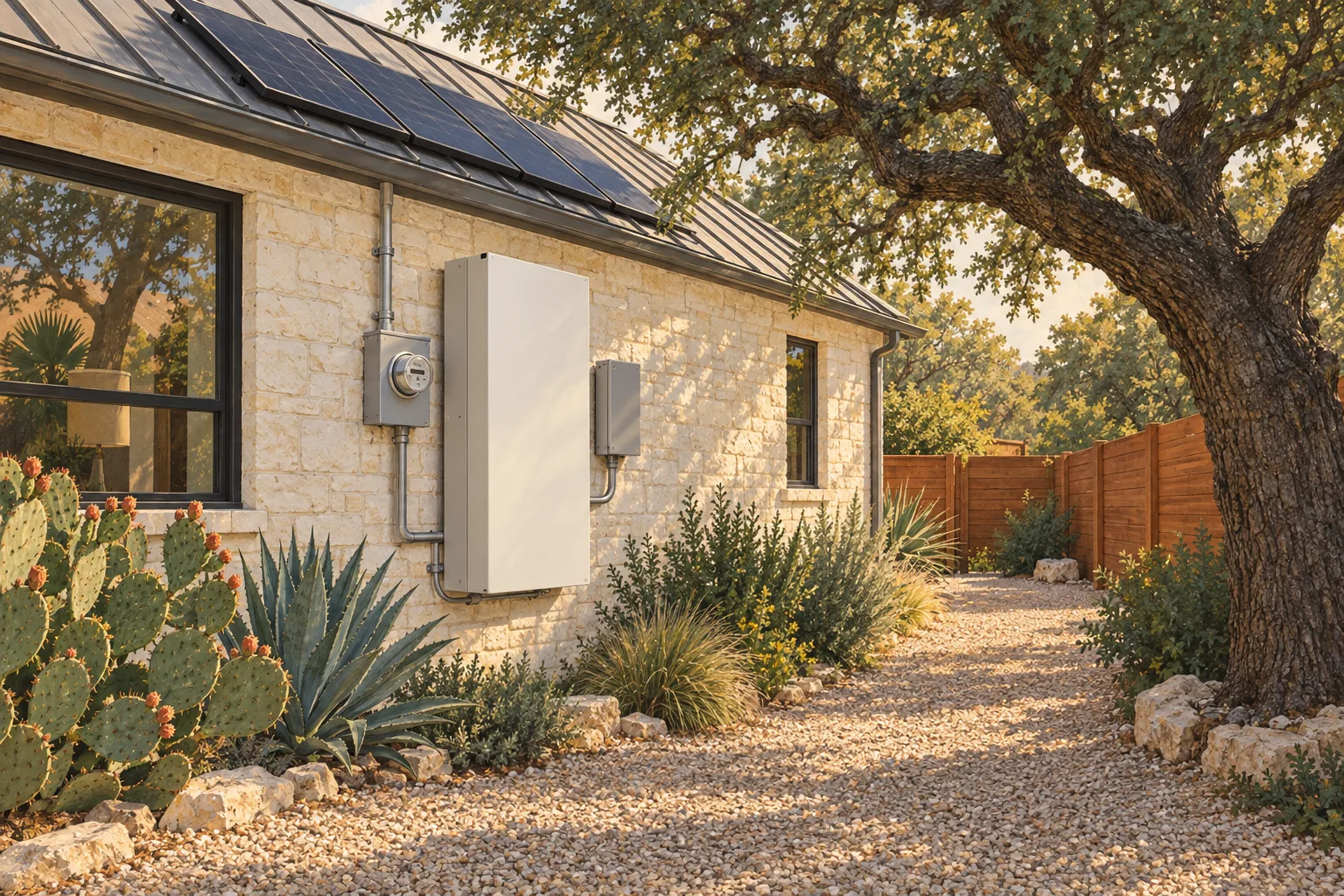
If you are buying or selling a house in Austin, this changes what you may find bolted to the side wall, and it adds a question the standard disclosure form does not ask: who owns that equipment?
Solar permits down 54%, battery permits nearly four times higher
| Year | New solar, Jan. 1 to Nov. 20 | New solar, full year | Battery, Jan. 1 to Nov. 20 |
|---|---|---|---|
| 2019 | 1,623 | 1,845 | 14 |
| 2020 | 1,687 | 1,899 | 25 |
| 2021 | 1,871 | 2,105 | 287 |
| 2022 | 1,682 | 1,899 | 302 |
| 2023 | 1,310 | 1,424 | 236 |
| 2024 | 985 | 1,054 | 236 |
| 2025 | 680 | 745 | 237 |
| 2026 | 314 | not yet complete | 917 |
Two things stand out. First, solar did not fall off a cliff this year. It has been sliding since 2021, when the City issued 2,105 home solar permits. By 2025 the full-year figure was 745. This year's 314 is 54% under last year on the same dates and 83% under 2021.
Second, batteries used to ride along with solar. In 2025, 198 of the 237 battery permits through November 20 were part of a solar job. This year 852 of 917 are for a battery with no solar on the permit at all. Add solar and batteries together and Austin has issued 1,185 of these permits in 2026, more than in all of 2025 (802) or all of 2024 (1,139). The mix is what flipped.
822 permits, one description, one contractor
| Month issued | Base Power battery permits | New solar permits |
|---|---|---|
| July | 18 | 29 |
| August | 137 | 44 |
| September | 174 | 36 |
| October | 255 | 40 |
| November 1 to 20 | 238 | 28 |
| Total | 822 | 177 |
The background is public. On May 19, 2026, Austin Energy announced an agreement with Base Power for 40 megawatts of residential battery storage across its service territory, which it said came out of a February 2025 request for proposals. The utility plans to call on the batteries during peak demand. The release says Base Power handles installation and maintenance, and that Austin Energy is not part of any agreement or billing between Base Power and its customers.
Base Power's page for Austin Energy customers lists the terms it advertises: $695 to install, a $19 monthly membership fee, and a 39.2 kilowatt-hour battery that it says can carry a home for up to 36 hours with reduced use. The page says the battery "sits in front of your electric meter, rather than behind it like most residential storage systems," which matches the "additional meter socket" on the permits. It also says your Austin Energy bill does not change and that the battery will not discharge to the grid during an outage.
What the permit records add is the pace and the map. The median permit was issued 15 days after it was applied for. Of the 822, 641 are inside Austin's full-purpose city limits. The other 181 list a different jurisdiction on the permit, including Austin's extraterritorial and limited-purpose areas, Lakeway, Bee Cave, West Lake Hills and Rollingwood. They are spread across 39 ZIP codes, and five of them (78731 with 88, 78746 with 72, 78759 with 49, 78757 with 47 and 78704 with 42) hold 298, a little over a third. That is a count of permits, not a ranking of places.
Two more figures a buyer can use. As of this pull, 287 of the 822 permits are marked Final and 535 are still Active, which is what you would expect for work this recent. And 133 of the 814 properties, about 16%, also have a solar permit somewhere in the City's records, so most of these batteries are going on houses with no solar history.
What changed for rooftop solar
The federal credit for a homeowner who buys a solar system is gone. The IRS guidance on the 2025 tax law (fact sheet FS-2025-05) says the residential clean energy credit "will not be allowed for any expenditures made after December 31, 2025," and that an expenditure counts as made when the installation is completed, not when it is paid for. You can see the deadline in the permits: the City issued 91, 93 and 88 new solar permits in September, October and November 2025, the three busiest months of that year, and no month since has passed 46. The permit record cannot tell you why any one household did or did not go solar, and the decline began three years before the credit ended.
Austin Energy has changed its own offer twice this year. In April it began supporting residential solar leases, in which, in the utility's words, "a third-party commercial company owns and maintains the equipment," usually for 20 to 25 years. Its home solar page, last reviewed October 1, 2026, now lists a $4,000 rebate for eligible projects of 3 kilowatts or larger installed by a participating contractor, up from the $2,500 in the April release, and a Value of Solar credit of 12.89 cents per kilowatt-hour produced. The same page says power purchase agreements are not allowed in Austin Energy's territory, that solar panels alone will not keep the lights on in an outage, and, for leases, to confirm "the process for a home sale."
Tax rules are specific to your situation. A CPA or the IRS is the place to confirm what applies to you.
What this means if you're buying, selling or renting here
- Buying a house with a battery on the wall. Ask who owns it. A battery the seller bought outright is theirs to sell with the house. A battery on a membership plan may belong to the company that installed it. Base Power's public page does not say what happens when the home sells, so ask the seller for the agreement itself and read the parts on transfer, removal and fees before the option period ends. Then look up the address in the City's permit records and note whether the battery permit is Final or still Active.
- Buying a house with solar. Ask whether the system is owned, financed or leased, and get the lease, the loan payoff or the proof of purchase in writing. Ask for the Austin Energy interconnection paperwork too. Of the 9,172 home solar permits the City issued from 2019 through 2023, 1,001, or 11%, are marked Expired today, meaning the permit ran out before a final inspection was recorded. Our piece on expired home permits walks through the lookup and what the City says about who answers for one.
- Selling. The Texas Real Estate Commission's Seller's Disclosure Notice (form 55-1) has no line for solar panels or a battery; we searched the form's text and neither word appears. A buyer's agent will ask anyway. Have the contract, the monthly cost, the transfer terms and the permit status ready before you list, and tell your title company early if a third party owns equipment on the house.
- Renting. If the house you rent has a battery or panels, ask the landlord in writing whether the backup covers your unit and who pays any monthly fee. Adding either one changes the building's electrical service, which is the owner's decision, not the tenant's.
None of this is a statement about what a battery or solar system does to a home's price, and it is not a recommendation for or against any company. The permit count does not measure either.
Where to look next
- Last Sunday's record: Austin pool permits and the one in six that expired.
- The full permit history at an address, including electrical permits, is searchable on Zabalist.
- The City's own dataset, Issued Construction Permits, if you want to check our counts.
- Flood, parcel and tax context for a specific home: our address research tool.
How we pulled this
We counted City of Austin electrical permits (type EP) with permit class Residential and work class Auxiliary Power, by issue date, in the Zabalist research database, which mirrors the City's Issued Construction Permits dataset. Each permit number is counted once, and permits marked Void, Withdrawn or Cancelled are left out. We sorted them by the words in the description. A permit to take panels off for a new roof and put them back is not counted as new solar. The database's freshness log shows its last full permit sync as November 15, 2026, but the permit table held records through issue date November 20 when we pulled it, so we re-ran the key counts against the City's open-data feed, last updated November 21, 2026: 822 permits containing "BASE:", all listing Base Power as contractor, 287 Final and 535 Active, and 127 residential Auxiliary Power permits for the week. All matched. Text matching is imperfect, so treat the solar and battery columns as close counts, not audited ones. Solar or batteries installed under a new-house building permit, and anything outside the area where the City of Austin issues electrical permits, are not included. Percentages are our arithmetic.
One next step
If a house you are considering has a battery or panels on it, talk to a local Austin Local Team agent and ask for the address's permit history and the equipment paperwork alongside the listing.