Listen to this article 12:12
Jump to a section
Read aloud by an AI voice (ElevenLabs) from the text on this page, which is the full transcript. Tables are summarized in the audio; see them below.
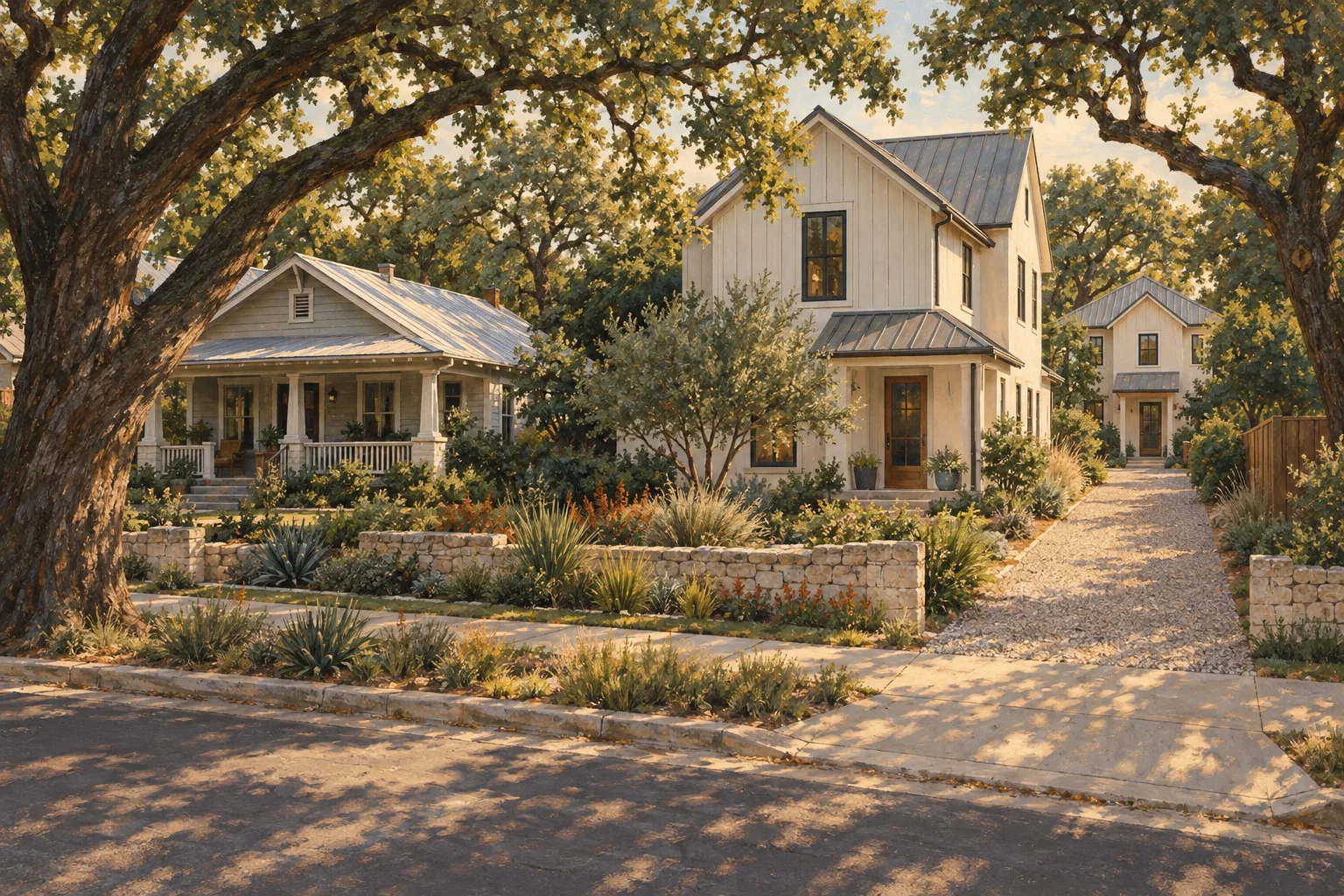
Walk South 2nd Street in Bouldin Creek and count front doors, then count lots. The numbers don't match. A house faces the street, a second house sits behind it down a shared driveway, and each has its own mailbox, its own owner and its own account on the appraisal roll. Neither owner holds a deed to the ground under the house. On paper, both houses are condominium units.
The Travis Central Appraisal District's 2026 roll shows how common that has become. Of the 286 detached houses in Bouldin Creek built in 2015 or later, 89 are carried as condominium units. That is 31%. In 2018 and 2019, the condo houses outnumbered the ones built on their own lots, 49 to 38.
From the sidewalk the two kinds of house look alike. In the contract, the loan file and the insurance policy they are different products. Here is what the records show, and what to read before you buy or sell one.
Which Bouldin Creek we counted
Austin has no legal neighborhood boundaries, so we used the City of Austin's planning-area map outline for Bouldin Creek, west of South Congress Avenue and north of Oltorf Street. Inside it the appraisal roll lists 1,340 detached houses. The streets with the most of them are Bouldin Avenue, South 3rd Street, West Johanna Street, West Mary Street and West Live Oak Street. Our Bouldin Creek neighborhood page has the wider picture.
Of those 1,340 houses, 1,174 sit on their own lot and 166 are units in a condominium. The own-lot houses skew old: 547 were built before 1950, with a median of 1,384 square feet of living area. The same outline also holds 157 townhouse-style condo units, 543 units in stacked condo buildings and 58 duplexes. This piece is about the detached ones, because they are the ones a buyer can mistake for something else.
What makes a house a condo
"Condominium" describes ownership, and it does not depend on the shape of the building. The Texas Uniform Condominium Act, Property Code chapter 82, says real property is a condominium "only if one or more of the common elements are directly owned in undivided interests by the unit owners." An owner records a declaration, the declaration draws the boundaries of each unit, and whatever is not a unit is a common element that the unit owners hold together.
On a two-house lot, that usually means each owner owns a house, and the two of them together own the land, the driveway and often the fence line. The declaration can assign a yard or a parking space to one unit as a limited common element, which the statute defines as a common element set aside for the exclusive use of one or more units but fewer than all. You use that yard. You do not own it outright, and the declaration says what you may build on it.
The lot itself is never divided. That is the point of the structure: two houses can be sold to two buyers without a subdivision plat.
The record, year by year
| Year built | Houses on their own lot | Houses that are condo units |
|---|---|---|
| 2015 | 23 | 7 |
| 2016 | 20 | 4 |
| 2017 | 16 | 4 |
| 2018 | 20 | 22 |
| 2019 | 18 | 27 |
| 2020 | 15 | 7 |
| 2021 | 19 | 1 |
| 2022 | 33 | 11 |
| 2023 | 15 | 2 |
| 2024 | 7 | 4 |
| 2025 | 11 | 0 |
| 2015 to 2025 | 197 | 89 |
The two groups are built differently. The 197 own-lot houses have a median of 2,878 square feet; 81 of them are 3,000 square feet or more and 121 carry a pool on the appraisal record. The 89 condo houses have a median of 1,579 square feet, 25 of them are 1,100 square feet or smaller, and 14 have a pool. Nearly all of both groups are two stories.
The appraisal account numbers group the 89 into 36 sites. Twenty-two are plain pairs, two new houses on one lot. In those pairs the larger house has a median of 2,238 square feet and the smaller one 1,046, and in 18 of the 22 the smaller house is 1,100 square feet or less: a main house and a back house, sold separately. Eleven sites have one newer house whose partner is older or is not a detached house. The other three are small clusters of 4, 7 and 23 houses. That last one, on South 2nd Street, is why that street has 33 of the 89. South 3rd Street has 13.
| Area | Houses built 2015 or later | Condo units among them | Share |
|---|---|---|---|
| Bouldin Creek | 286 | 89 | 31% |
| ZIP 78704 | 1,569 | 513 | 33% |
| ZIP 78702 | 1,641 | 1,050 | 64% |
| ZIP 78745 | 1,092 | 839 | 77% |
| Travis County | 68,920 | 11,149 | 16% |
Bouldin Creek is not an outlier. It sits close to the 78704 figure, and East Austin's 78702 and South Austin's 78745 run far higher. Across the county, about one new house in six since 2015 is a condo unit. Our earlier look at how lots shrank as houses grew covers the houses that do sit on their own lot.
What changes when the house is a unit
The contract. Texas has a separate form for this. The Texas Real Estate Commission's Residential Condominium Contract (Resale), form 30-18, effective July 1, 2026, is "not for use where the seller owns fee simple title to the land beneath the unit," which tells you what the form assumes about the land. Paragraph 2 describes what you are buying as the unit "together with such Unit's undivided interest in the Common Elements."
The documents. The same paragraph names the declaration, bylaws and rules as the "Documents." If you have not received them when you sign, the form gives you 7 days after you get them to terminate and have the earnest money refunded. It works the same way for the resale certificate. Property Code section 82.157 lists what that certificate must state, including the periodic assessment, any unpaid amounts, the reserves, pending lawsuits against the association and "insurance coverage" for the owners' benefit, and it gives the association 10 days to produce one after a written request. A two-house condominium still has an association, even when it is two neighbors and no management company. Some have a budget of zero and no reserve. The certificate is where you find out.
The loan. Lenders review condominium projects, but detached units get lighter treatment. Fannie Mae's Selling Guide waives project review for a detached condo, which it defines as "any condo unit that is completely detached from other condo units in the project." The insurance requirements and the rule on priority of common-expense assessments still apply. Other loan programs set their own rules, so ask your lender early and give them the declaration.
The yard and the driveway. What you can fence, pave, plant or add onto is set by the declaration and by the other owner's rights, on top of City zoning. Maintenance of the shared driveway, the shared utility lines and sometimes the exteriors is whatever the declaration says. Read who insures the structures, too. Some declarations have each owner insure a whole house; others split it another way.
The tax bill. Each unit has its own appraisal account and its own bill. Look both of them up on the Travis Central Appraisal District site, yours and the neighbor's, to see how the district has split the land between the two.
Where the City's newer rules fit
For years the condominium was the practical way to sell two houses on one central Austin lot. The City's HOME amendments added options. Phase 1, adopted Dec. 7, 2023, allows "up to three housing units, including tiny homes," on lots zoned SF-1, SF-2 or SF-3, with applications accepted from Feb. 5, 2024. Phase 2, adopted May 16, 2024, created a one-house use on lots "of at least 1,800 square feet but less than 5,750 square feet," accepted citywide from Nov. 16, 2024. As of the City's Nov. 4, 2026 update, 767 Phase 1 applications had been approved for 1,529 new units.
A builder can now subdivide a lot into small ones and sell each house with its own land, or put three units on one lot and sell them as condos. Bouldin Creek's count for 2024 and 2025 is small either way: 18 own-lot houses and 4 condo houses. It is too early to say which route builders here will take. Permit history for any address is on Zabalist's permit records.
What this means if you're buying, selling or renting here
Buying. Before you tour, look the address up on the appraisal district site. A legal description that names a unit and a condominium, not a lot and block, tells you which kind of house it is. Then ask for the declaration, bylaws, rules and resale certificate before you write the offer, and read the sections on insurance, maintenance, limited common elements and changes to the exterior. Find out who owns the other unit and whether the two of you would be the whole association. A real estate attorney can read a declaration in an hour, and it is worth the hour.
Selling. Order the resale certificate early. The association has 10 days to deliver it, and in a two-unit regime "the association" may be you and the neighbor, with no one in the habit of producing paperwork. Have the recorded declaration and any amendments ready, and know your assessment, even if it is zero. Buyers comparing your house with an own-lot house down the street will ask what the difference is. Have the answer ready.
Renting. A lease on a condo house is with the unit's owner, and the declaration's rules on parking, pets and the shared driveway bind tenants too. Ask the owner for the rules before you sign.
How we pulled this
We selected Travis Central Appraisal District 2026 roll records for detached dwellings in two groups: state code A1, a house on its own parcel, and code A4, the district's condominium code, where the improvement is typed as a one-family dwelling. Own-lot houses were placed by the center of their parcel. Condo units have no parcel shape of their own, so we matched each unit's street address to the City of Austin's address points; every Bouldin Creek unit matched exactly. The outline is the City's planning-area boundary with its vertices thinned slightly. Sites are grouped by the first eight digits of the appraisal account's geographic ID. Across ZIP 78704, 17 detached condo units could not be placed and are left out of the neighborhood count. Year built and living area are the district's figures, and a house built earlier and converted to a condominium later keeps its original year. Percentages, medians and sums are our arithmetic. This is general information, not legal, lending or tax advice about a particular property.
One next step
If a Bouldin Creek house you like turns out to be a unit, a local agent can get the declaration and resale certificate in front of you before you make an offer. Start at our get started page.