Listen to this article 11:52
Jump to a section
Read aloud by an AI voice (ElevenLabs) from the text on this page, which is the full transcript. Tables are summarized in the audio; see them below.
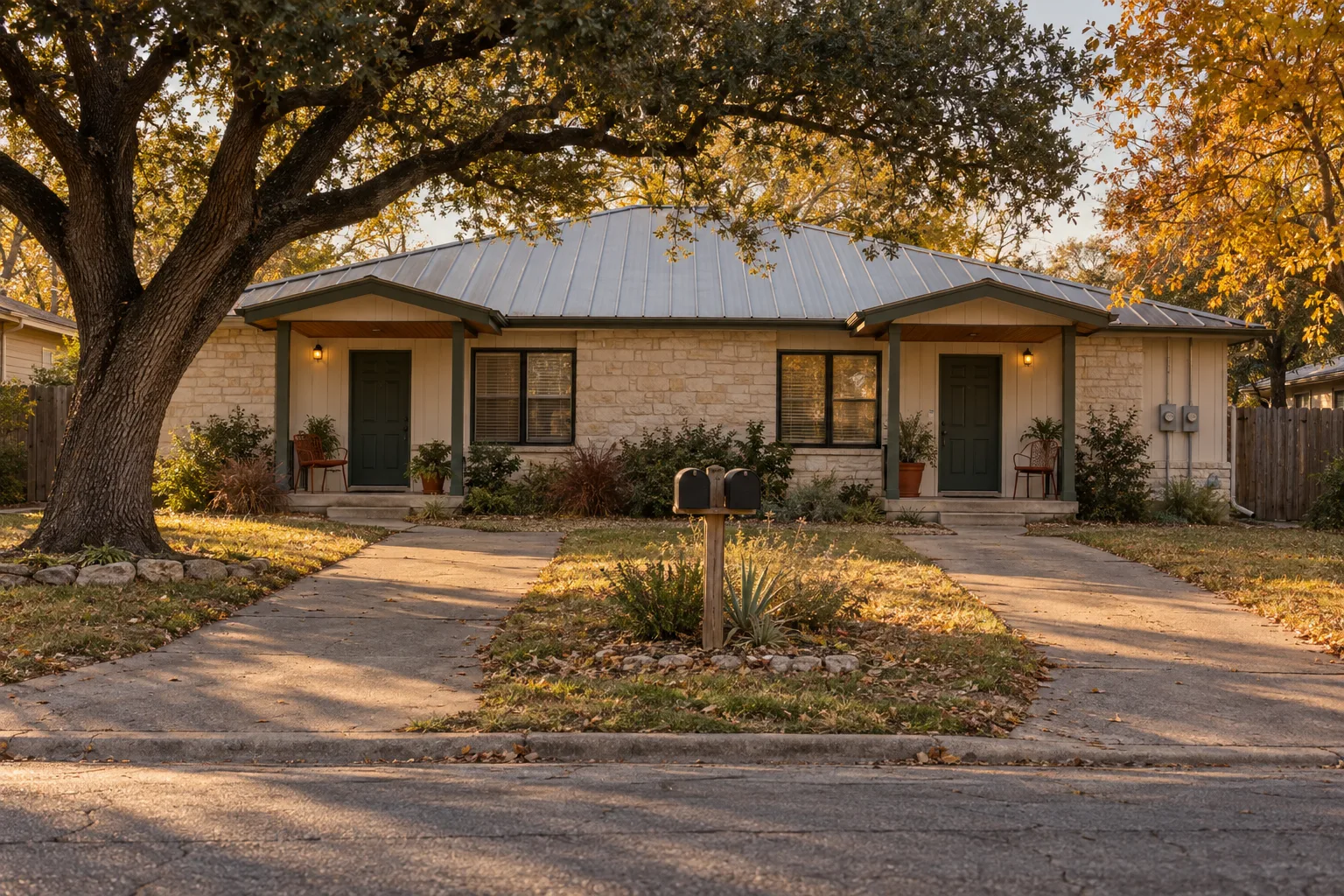
On January 1, 2027, Austin's rental fee disclosure rule stops being a big-complex rule. Since October 1 it has applied only to landlords and managers with 50 or more homes. In five weeks it reaches everyone who rents, leases or manages five or more dwellings owned by one person. That is the part of the market most renters picture when they think of a duplex on a side street.
The appraisal roll gives a sense of how much housing that is. Inside Austin's city limits in Travis County, the Travis Central Appraisal District classes 10,043 properties as two-, three- or four-unit residential buildings: 8,902 duplexes, 130 triplexes and 1,011 fourplexes. Counted by the units their class implies, that is roughly 22,000 homes. Nine in ten of those buildings went up before 1990. On 84% of them, nobody claims a homestead exemption, which means the owner does not tell the appraisal district they live there.
What the rule requires, who it skips, and what Texas law already gives a duplex renter regardless of the landlord's size are below.
What changes on January 1
The City Council adopted Ordinance No. 20260528-045 on May 28, 2026. It adds a fee disclosure article to City Code Chapter 4-14. A covered provider must give a prospective tenant a written, itemized list of total fees "at the earlier of" quoting the rent or before the person submits an application. The list has to show mandatory fees (rent plus any required one-time or recurring fixed fee), optional fees, and an estimate of variable fees such as utilities. An ad that mentions the cost to rent has to include the rent and any mandatory recurring fixed fees.
The ordinance covers a person who leases, rents or manages "five or more dwellings that are owned by one person and are used as a residence," plus anyone renting mobile home or RV spaces. Part 3 phases it in: 50 or more dwellings from October 1, 2026, and fewer than 50 from January 1, 2027. Fees for tenant-caused damage or lease violations are excluded. A violation is a misdemeanor, and a provider who fills out the City's standard form accurately is presumed to comply. Austin Equity and Inclusion enforces it and takes complaints online, by phone at 512-974-3251, or in person at 505 Barton Springs Road, Suite 515. The page also says the ordinance does not pay tenants back for fees that weren't disclosed.
We covered the October rollout, including the fee categories, in our first piece on the ordinance. This one is about the smaller buildings.
Austin's two-to-four-unit buildings, by the numbers
We matched every 2026 roll property in the appraisal district's duplex, triplex and fourplex classes to its parcel and kept the ones whose parcel center falls inside Austin's city limits. Homestead status comes from the same roll's exemption records.
| Class | Buildings | Median year built | Median living area (sq ft) | With a homestead exemption |
|---|---|---|---|---|
| Duplex | 8,902 | 1979 | 1,948 | 1,536 (17.3%) |
| Triplex | 130 | 1960 | 2,779 | 23 (17.7%) |
| Fourplex | 1,011 | 1977 | 3,526 | 45 (4.5%) |
| All | 10,043 | 1979 | 2,008 | 1,604 (16.0%) |
Living area is for the whole building, so a typical duplex is two homes of roughly 975 square feet each. The age profile is lopsided. 4,630 buildings (46%) were built before 1978, and another 4,516 (45%) went up between 1978 and 1989. Only 140 (1.4%) on the roll were built in 2016 or later. That doesn't mean Austin stopped building two-unit homes. Many newer pairs are recorded as two condominium units, each its own account in a different appraisal class, which we found in our Bouldin Creek count and in 2025's duplex permits. Those don't show up here.
The Census Bureau's American Community Survey shows the same thing at county scale. Travis County had 35,121 homes in two-to-four-unit buildings in the 2020–2024 estimates, up from 32,796 in 2010–2014. Over the same span their share of all homes fell from 7.2% to 5.7%.
Where they are
| ZIP | Buildings | Built before 1978 | With a homestead exemption |
|---|---|---|---|
| 78745 | 1,284 | 31.5% | 13.0% |
| 78758 | 1,151 | 37.3% | 12.4% |
| 78704 | 1,024 | 72.7% | 22.4% |
| 78744 | 685 | 8.6% | 10.2% |
| 78748 | 581 | 0.7% | 8.3% |
| 78753 | 548 | 29.6% | 14.2% |
| 78741 | 426 | 70.2% | 19.5% |
| 78757 | 425 | 87.5% | 21.6% |
| 78723 | 420 | 73.1% | 14.5% |
ZIP is the appraisal district's situs ZIP. The split is mostly about when each part of town was subdivided. In 78748 almost every duplex dates from 1978 or later. In 78757 nearly nine in ten are older than that.
Is your duplex covered? It depends on the landlord, not the building
The ordinance counts dwellings by owner, not by building. A single fourplex is four dwellings, so on its own it falls under the threshold. An owner with three duplexes has six and is covered. You can't tell which kind of landlord you have from the curb, and the appraisal roll alone won't tell you either, because the same owner can hold buildings under different names.
Texas law gives you a way to ask. Property Code Section 92.201 requires a landlord to disclose the name and address of the holder of record title and, if an off-site company manages the place, that company's name and street address. If the information isn't already in your lease or posted, the landlord has seven days from your request to provide it in writing or post it. With an owner name, you can look up what else is held under it on the Travis CAD property search. If a manager or owner says the rule doesn't apply and you think it does, Equity and Inclusion's investigators are the ones to ask.
The homestead figure matters here too. In 1,604 of these buildings, the owner claims a homestead. Texas Tax Code Section 11.13(j) lets an owner claim one on "a separately secured and occupied portion of a structure," so in those buildings the owner usually lives in one of the units. That says nothing about whether they own other rentals. It just means the landlord is often next door.
What applies whatever the landlord's size
The city fee rule has a threshold. These don't:
- Security deposit. Under Property Code Section 92.103, the landlord must refund the deposit by the 30th day after you surrender the premises. A required advance notice to get it back counts only if it is underlined or in conspicuous bold in the lease. Under Section 92.109, missing that deadline without returning the deposit or giving an itemized list of deductions creates a presumption of bad faith, which can mean $100 plus three times the amount wrongly withheld and attorney's fees. The statute also ties the refund to a forwarding address, so give one in writing.
- Lead paint notice, for 4,630 of these buildings. For housing built before 1978, federal rules require the landlord to give you EPA's lead pamphlet, disclose any known lead-based paint or hazards and any reports, and include a lead warning statement in the lease, all before you sign, according to EPA's disclosure page. Leases of 100 days or less and zero-bedroom units are among the exemptions. Our pre-1978 houses piece explains what the notice covers.
- Ask about utilities before you apply. In a small building, the variable-fee line is often the real number: is water on one meter, and how is it split? Covered landlords have to estimate it in writing starting January 1. Smaller ones don't, but you can still ask for the same thing.
One more item is in the City's backup documents. A draft College Student Commission recommendation, numbered 20261113-004, asks Council to amend the same chapter to require a written natural-light disclosure for each bedroom offered for rent. The posted copy has no vote recorded. It's a proposal, not a rule.
What this means if you're renting, buying or selling here
If you're renting: from January 1, ask any landlord or manager for the total-fee list before you pay an application fee. If they say they're under five dwellings, ask for the owner's name under Section 92.201 and check it yourself. The tenant protections above apply either way.
If you own or are buying a duplex or fourplex to rent out: count every dwelling you own, not just this building. Five or more means the City's disclosure form and fee-inclusive ads from January 1. Using the City's form accurately is the presumption of compliance the ordinance offers. 1,325 of these buildings, about one in eight, changed hands on a deed recorded since January 2024, so plenty of owners are new to their paperwork.
If you're selling one: a buyer who plans to rent it will ask how the current leases handle fees and utilities. Having that written down helps.
This is general education, not legal advice. For a question about a specific lease or building, talk to a licensed attorney, a tenant counseling service, or the City's Equity and Inclusion office.
How we counted, and what the count misses
- "Buildings" are appraisal accounts in state classes B2, B3 and B4 with a recorded living area, one per account, matched to a parcel whose center falls inside Austin's city limits as of the August 19, 2026 regional boundary file. The Williamson County part of Austin isn't included.
- Unit counts are implied by class (two, three or four). The roll doesn't list units per account, and some buildings hold an accessory unit the class doesn't reflect.
- A homestead exemption is a tax filing, not a census of who lives where. An owner who lives on site but hasn't filed shows up as "no homestead."
- Duplex pairs recorded as two condominium units, houses with a backyard unit, and single-family rentals aren't in the count.
- Deed date is the latest recorded on the 2026 roll as loaded October 7, 2026.
If you want the flood, tax and utility district layers for one address before you sign or make an offer, run it through our research tool.
Sources
- Austin Local Team analysis of Travis Central Appraisal District 2026 roll improvement and exemption records (loaded October 7, 2026), parcel outlines (refreshed November 5, 2026) and CAPCOG regional city limits (Austin boundary updated August 19, 2026); look up a property at Travis CAD property search
- U.S. Census Bureau, American Community Survey 5-year estimates, units in structure, Travis County tracts, 2010–2014 and 2020–2024
- City of Austin Ordinance No. 20260528-045 (passed May 28, 2026), City Code Chapter 4-14, Article 4
- Austin Equity and Inclusion, Rental Fee Transparency Ordinance
- College Student Commission Recommendation 20261113-004, Rental Housing Natural Light Disclosure
- Texas Property Code §92.103, §92.109 and §92.201; Texas Tax Code §11.13
- U.S. EPA, Real Estate Disclosures About Potential Lead Hazards