Barton Hills, Bouldin Creek, Hyde Park and Mueller offer different starting points for an Austin home search. The useful comparison is the life you can build around a particular address: where you go outside, how you buy groceries, which trips are easy to repeat and what the home requires of you.
This guide gives each area a concrete research anchor and a set of questions to take on a visit. It does not rank residents, schools or neighborhood character. Use the same routine and housing requirements across all four, then narrow the search using the evidence you gather at actual properties.
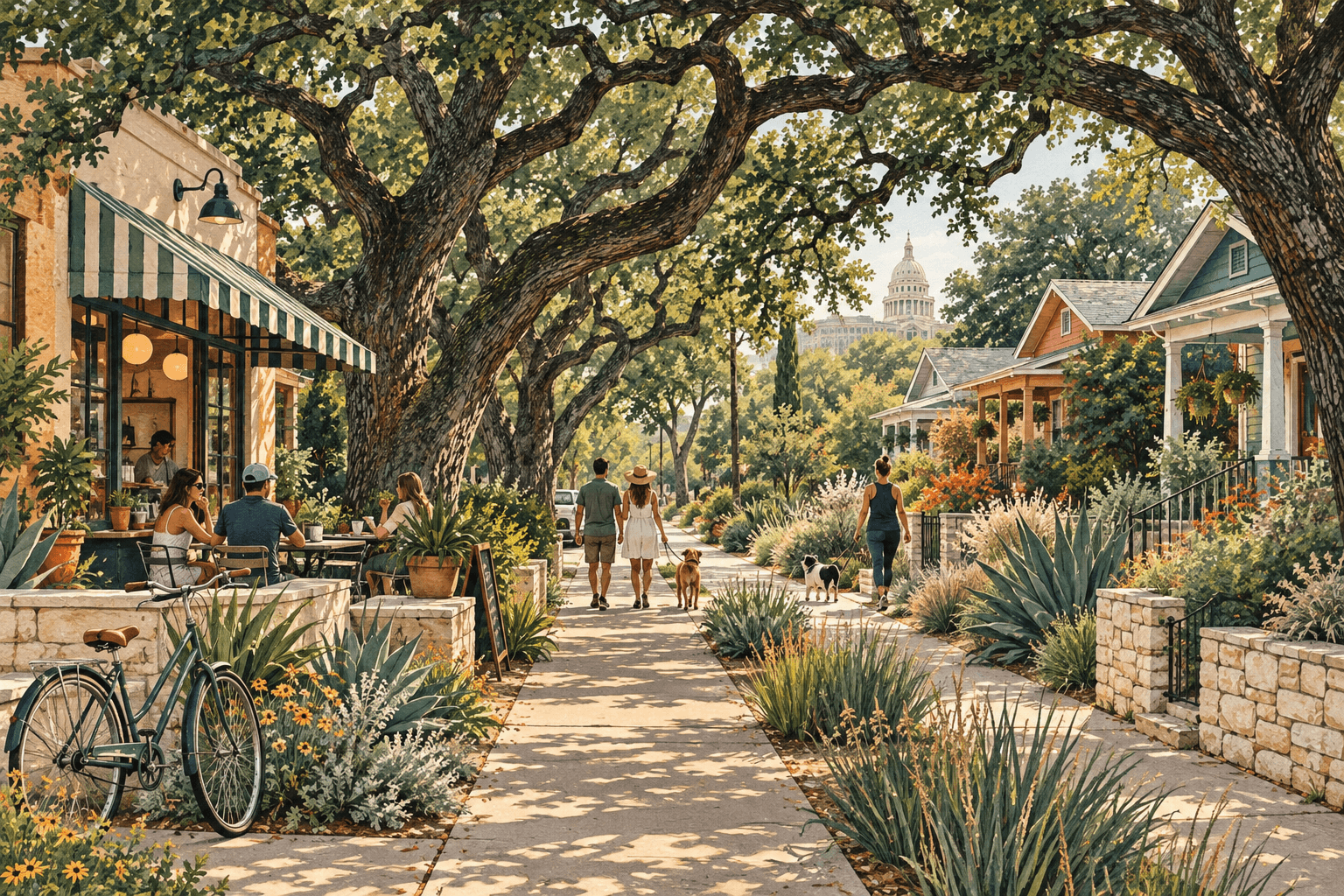
Living in Austin: choose your best fit
The best Austin neighborhood for you is one where an available home meets your essential requirements and the surrounding routes support the week you want. Start here with four research anchors: greenbelt entrances in Barton Hills, an errand-and-park loop in Bouldin, property history in Hyde Park and the park network in Mueller. These are lenses for comparing addresses, not exclusive identities for the areas.
Barton Hills: start with the greenbelt entrance
For Barton Hills, begin with a public trail entrance. The City of Austin’s greenbelt page identifies Gus Fruh and Homedale access points, among others. AustinTexasThings’ Barton Hills editorial research uses those entrances to distinguish a planned outing from the broad idea of being near the creek.
The practical tradeoff to test is outdoor access versus your other journeys. Pick a candidate home, walk its route to your preferred entrance and then make a separate grocery or work trip. Record both. A rewarding trail route does not answer whether the rest of the week works from that address.
Look at the home’s outdoor spaces and ask who maintains them. If the setting is a major reason for your choice, include access documentation and property-specific drainage questions in the research. Avoid giving every home in the area credit for an entrance you have only tested from one block.
Bouldin Creek: build a loop through actual destinations
Bouldin’s green-space names need careful reading. The city’s park directory lists East Bouldin Creek Greenbelt, West Bouldin Creek Greenbelt and Nicholas Dawson Neighborhood Park as distinct destinations. The last is listed at 704 West James Street. A park name is not proof of a continuous trail or a neighborhood boundary.
Choose a home and design a small everyday loop: an errand, a park stop and the return. Test the crossings and street segments between those destinations. If the attraction is combining several outings without a separate trip for each, this exercise shows whether the specific address delivers that benefit.
Compare an address nearer your chosen commercial destination with one farther from it. Visit the actual home at the hours you expect to be there. Assess the sound and access you observe rather than assigning the same level of activity to every street in Bouldin.
Hyde Park: connect the local routine with property history
Hyde Park offers a useful cultural anchor in Elisabet Ney’s former studio. The museum’s official page currently says it is closed for renovation and anticipates reopening in spring 2027. Treat that as a forecast and check current program locations; normal museum admission should not be part of an immediate touring itinerary.
For a home search, test the routes to the places you will use weekly and inspect the property itself. If an older home or a renovation opportunity appeals to you, identify its actual historic status using city resources. Do not infer a property’s rules from the neighborhood name, its apparent age or a listing’s description.
The city’s Historic Preservation pages provide a starting point for researching designation and review. Bring a specific proposed change to the city and your advisers before building a renovation plan around it. The comparison with another home should include your tolerance for maintenance and project uncertainty, not just the appeal of its architecture.
Mueller: distinguish the park network from each amenity
Mueller’s official parks guide identifies Girard Kinney Park as the former Lake Park and describes the restored prairie at Southwest Greenway. Those are useful contrasting stops: one visit can test the route to a lake-centered gathering space and another the route to a different landscape.
The same guide says Mueller’s parks are open to the public, while directing readers separately to pool information. General park access does not establish entitlement to every amenity. Ask which facilities, reservations or association arrangements apply to the exact home you are considering.
Use AustinTexasThings’ RMMA page to explore dated public records in the city planning area. RMMA refers to Robert Mueller Municipal Airport, the historical dataset label. A recorded permit is a research lead; it does not establish that work is complete, that a business is open or that a nearby home’s value will change.
Use one comparison method across all four
Choose the same three destinations for every candidate: a recurring obligation, a normal errand and an outdoor or cultural stop you want to use often. Test trips at your actual travel times. CapMetro’s Trip Planner can help investigate transit alternatives; check both directions before counting a route as useful.
Keep housing observations separate from location observations. Write down what is confirmed about the home, what you personally observed on the route and what still requires a professional or document review. This prevents a lovely park visit from obscuring an unresolved property issue, or one difficult showing from defining an entire area.
Give each requirement a priority in your own words: essential, useful or optional. Do not add them into a universal neighborhood score. A single essential requirement can outweigh several pleasant extras. Take the resulting shortlist into the next conversation with the addresses, routes and unanswered questions attached.
Questions worth asking
Are these neighborhood names exact boundaries?
Names used in listings and conversation may differ from city planning areas, historic districts and ZIP codes. Use the relevant official map for a boundary-based question and verify the property address.
Why does AustinTexasThings call Mueller RMMA?
Its neighborhood atlas uses the city planning dataset’s historical Robert Mueller Municipal Airport label. The page explains that geography; the label should not be treated as a separate lifestyle score.
Can this comparison tell me which area is cheaper?
No current price ranking is claimed here. Compare currently available homes that meet the same requirements, including property-specific recurring costs and maintenance responsibilities.
Sources & further reading
Use the original source to confirm current access, schedules and records. A guide’s review date does not make every underlying record current.
- City of Austin: Barton Creek Greenbelt ↗
- AustinTexasThings: Barton Hills local research ↗
- City of Austin: Park Directory ↗
- City of Austin: Elisabet Ney Museum current status ↗
- City of Austin: Historic Preservation research ↗
- Mueller: official parks and amenity information ↗
- AustinTexasThings: Mueller / RMMA planning-area research ↗
- CapMetro: Trip Planner ↗